Fish and Techniques
Bluefish in Cape Cod Bay
Bluefish bring fast, sharp fishing to Cape Cod Bay in summer. Learn their habits, the tackle that survives them and how to handle a catch.
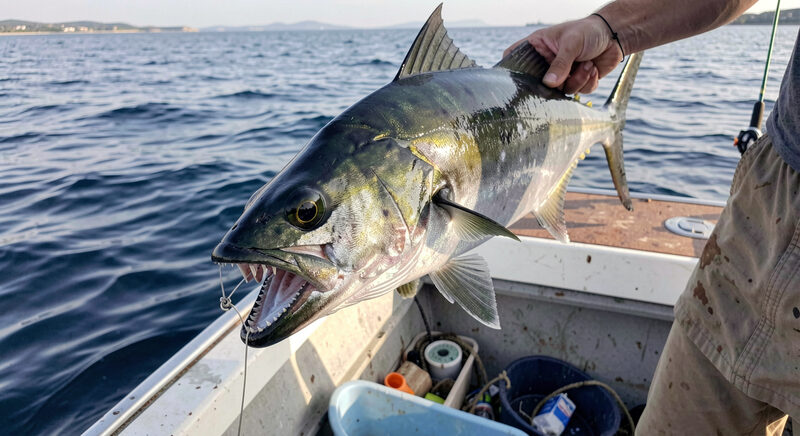
If the striped bass is the thoughtful side of Cape Cod Bay fishing, the bluefish is the loud one. It arrives in summer in fast-moving schools, it attacks bait with a violence that is hard to mistake, and when it is on the feed it will hit almost anything that moves. Bluefish are not subtle. They are strong, they are sharp, and they bring a kind of action that no other inshore fish on this coast quite matches.
They are also a fish that demands respect, both for their teeth and for their speed. This guide covers how bluefish behave in the bay, the tackle that survives them and how to handle a catch without losing a finger or a lure.
A summer visitor
Bluefish are a warm-water species that move north along the coast as the sea warms, reaching Cape Cod Bay in the summer months. They travel in schools, often of similar-sized fish, and they feed on baitfish with a ferocity that leaves slicks of oil on the surface and sometimes blood in the water. When a school of bluefish is working, the signs are usually obvious: birds, surface commotion and the occasional fish launching clear of the water.
Their presence in the bay overlaps with the striped bass season, so an angler fishing the shoals in midsummer may catch both on the same trip. The bluefish tend to be more mobile and more aggressive, moving quickly through an area and then disappearing, while the bass often hold in place longer.
Why they demand heavier tackle
Bluefish have rows of sharp teeth and a habit of cutting through leader material. A mono or fluorocarbon leader that would be fine for bass will be sliced by a bluefish in a moment. The standard answer is a wire leader, or a heavy bite tippet, at least when bluefish are around in numbers. Anglers who fish for bass with light leaders often lose fish to blues without ever seeing why.
Beyond the teeth, bluefish fight hard. They run, they shake their heads and they can be surprisingly strong for their size. A rod that feels crisp for bass is usually up to the job, but the leader and the knots have to be built for something with teeth. Even a landed fish needs care: a bluefish thrashing in a boat can bite, and its teeth will draw blood from an unwary hand.
How they feed
Bluefish are opportunistic feeders and they will take bait, lures and flies. When they are blitzing bait on the surface, almost any fast-moving lure will draw a strike, and the fishing can be frantic, with a fish on every cast. At other times they feed below the surface, and then jigs, spoons and trolled lures come into play.
The same rule that governs bass fishing applies here: find the bait. Bluefish are rarely far from the schools of baitfish they are hunting, and the birds that dive on those schools are the best guide an angler has. A boat that finds a working flock is usually a boat that finds bluefish.
Landing and handling a bluefish
Handling bluefish is a practical skill that protects both the angler and the fish. A landing net helps, and so does a firm grip behind the head rather than near the tail. Pliers or a purpose-made tool for removing hooks are essential, because reaching into a bluefish's mouth with bare fingers is a reliable way to get bitten. If the plan is to release the fish, keeping it in the water and unhooking it quickly gives it the best chance.
Bluefish are also good eating when handled well, though they do not keep as long as some species, so anglers who intend to keep one should ice it promptly. Many anglers on the bay release most of their bluefish and keep only what they will eat, treating the species as sport first and food second.
Where to meet them in the bay
Bluefish roam, so the question of where to find them is really a question of where the bait is. On Cape Cod Bay, that often means the shoals and the edges of the flats, where sand eels and other baitfish gather and where a moving tide concentrates them. Billingsgate Shoals is a regular summer stop, and the same birds that mark striped bass activity mark bluefish activity too.
Because the fish move, a boat that finds bluefish one morning may find them gone the next. That is part of the appeal. The angler who stays mobile, watches the surface and follows the birds is the one who keeps finding fish, while a boat that anchors to a memory of yesterday's success often sits over empty water. Bluefish reward a searching approach, whether that is trolling to cover ground or running and gunning from one patch of activity to the next.
A fish with a reputation
Bluefish have a long history on this coast, and not all of it is flattering. They are blamed, sometimes unfairly, for cutting off other fish and for their aggressive feeding, and older anglers tell stories of bluefish blitzes that left nothing behind. In truth, they are simply doing what a fast, hungry predator does, and their presence is a sign of a healthy bait supply.
What matters for an angler is to take them on their own terms. If you want a quiet, technical day, fish for striped bass on the flats. If you want action, noise and a fish that will try to remove your fingers and your leader in the same second, then a bluefish blitz is exactly what you are looking for.
A fast, honest fish
Bluefish do not pretend to be anything they are not. They are fast, aggressive and built to tear through bait, and that is exactly what makes them fun. For an angler who wants action rather than patience, a summer day with a school of bluefish on the shoal is hard to beat. The guide to Billingsgate Shoals covers one of the best places to meet them, and the fish and techniques section places them alongside the bass and tuna that share the bay. For the wider season, see the month by month guide.